- Home
- Contact Us
- Service areas
- Orlando Public Adjuster
- Lockhart FL Adjuster
- Apopka Public Adjuster
- Altamonte Springs
- Longwood Public Adjuster
- Casselberry Adjuster
- Deltona Public Adjuster
- Kissimmee Public Adjuster
- Lake Mary Public Adjuster
- Sanford Public Adjuster
- Edgewood Public Adjuster
- Eatonville Adjuster
- Conway Public Adjuster
- College Park Adjuster
- Dr Philips Adjuster
- Ocoee Public Adjuster
- Belle Isle Public Adjuste
- Maitland Public Adjuster
- Davenport Public Adjuster
- Winter Park Adjuster
- Home Insurance Claims
- Blogs
What Is the Average Cost of a Public Adjuster?
Understanding Public Adjuster Fees, Insurance Claims, and the Value of Professional Claim Representa
When a homeowner experiences roof damage, hurricane damage, wind damage, hail damage, fire damage, or water damage, one of the first questions they may ask is: “What is the average cost of a public adjuster?”
A public adjuster generally does not charge like a roofing contractor, attorney, or home inspector. Public adjusters commonly work for a percentage of the insurance claim recovery, although fee arrangements vary by state, circumstances, claim type, and contract.
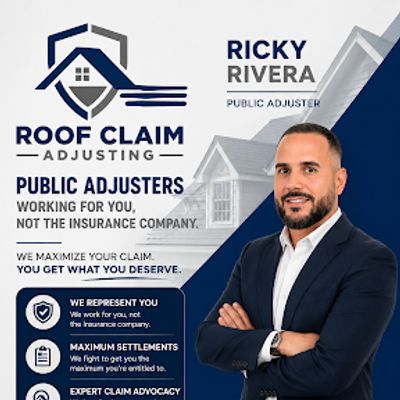
At Roof Claim Adjusting, we represent policyholders—not insurance companies. Our role is to inspect and document property damage, analyze the insurance claim, review applicable policy provisions, prepare estimates and supporting documentation, communicate with the carrier, and negotiate the property insurance claim on behalf of our client.
For Florida claims, public-adjuster compensation is regulated, and applicable limits can depend on circumstances such as whether a declared state of emergency applies. Homeowners should review the written contract and current Florida requirements rather than relying on a generic national percentage.
Roof Claim Adjusting
407-497-7093
How Much Does a Public Adjuster Cost?
Public adjuster fees are commonly structured as a percentage of the insurance claim proceeds or recovery addressed by the contract.
For example, rather than paying a large hourly consulting bill upfront, the policyholder and public adjuster may agree to compensation based on the results of the claim, subject to applicable Florida law and the written agreement.
The exact fee can depend on factors such as the type of property loss, size of the insurance claim, complexity of the damage, status of the claim, applicable Florida regulations, and services required.
Before hiring any public adjuster, ask for the fee structure in writing and carefully review the public adjusting contract.
What Are You Paying a Public Adjuster to Do?
A qualified public adjuster does much more than submit paperwork.
Depending on the engagement, professional public adjusting services can involve:
Property inspection: Examining the home, roof, interior, exterior, and other affected areas.
Damage documentation: Photographing, measuring, inventorying, and documenting property damage.
Policy review: Reviewing the insurance policy to understand relevant coverage, limitations, deductibles, exclusions, and endorsements.
Estimating: Preparing detailed estimates describing the scope and cost of covered repairs.
Claim preparation: Organizing evidence and supporting documentation for the insurance carrier.
Insurance communication: Communicating with adjusters and other carrier representatives regarding the property claim.
Negotiation: Advocating for the policyholder regarding the amount and scope of covered damage.
Supplemental claims: Documenting additional covered damage or costs discovered during the claims process when appropriate.
Is Hiring a Public Adjuster Worth the Cost?
That depends on your individual claim.
A relatively straightforward claim may not require professional representation. However, a public adjuster can be particularly valuable when a claim is large, complicated, disputed, underpaid, delayed, or denied.
Consider speaking with a public adjuster when:
- Your insurance company's estimate appears incomplete.
- Your roof claim has been denied.
- Your property claim appears underpaid.
- Significant damage was overlooked.
- You don't understand the insurance company's estimate.
- Your home has extensive hurricane or storm damage.
- Your commercial property suffered a substantial loss.
- Additional damage was discovered after the initial inspection.
- Managing the claim has become overwhelming.
- You want a licensed professional representing your interests.
The objective isn't simply to make a claim larger. A public adjuster's job is to help identify, document, estimate, and present covered damage accurately under the policy.
Who Does the Public Adjuster Work For?
This distinction is extremely important.
The insurance company may send an adjuster to inspect your property. That adjuster works for or on behalf of the insurance carrier.
A public adjuster represents the policyholder.
Roof Claim Adjusting represents homeowners and property owners during the insurance claims process. That means our responsibility is to our client rather than the insurance carrier.
Public Adjuster Cost for a Roof Insurance Claim
Roof claims can become complicated because the visible roof damage may be only one part of the loss.
A storm-related claim can potentially involve:
- Shingles
- Roof tiles
- Metal roofing
- Underlayment
- Roof decking
- Flashing
- Ridge caps
- Gutters
- Soffits
- Fascia
- Skylights
- Roof vents
- Interior ceilings
- Drywall
- Insulation
- Flooring
- Paint
- Water intrusion
A detailed inspection and estimate can therefore be important when evaluating the complete scope of damage.
What If My Roof Claim Was Denied?
A denial doesn't necessarily answer every question about a claim.
The first step is understanding why the insurance company denied it.
A public adjuster may review the denial, insurance policy, photographs, inspection information, estimates, and available documentation to determine whether additional claim work is appropriate.
However, no legitimate public adjuster should promise that every denied claim will be overturned.
What About an Underpaid Insurance Claim?
Sometimes an insurance company accepts coverage but the policyholder believes the estimate doesn't account for all covered damage.
Examples could include disagreements involving:
- Roofing quantities
- Interior repairs
- Material pricing
- Labor
- Additional damaged areas
- Scope of repairs
- Code-related items where applicable
- Necessary associated work
A public adjuster can document and present a different scope or estimate when supported by the facts and policy.
Residential and Commercial Public Adjusting
Roof Claim Adjusting assists with qualifying residential and commercial property insurance claims.
Claims may involve single-family homes, rental properties, condominiums, apartment buildings, offices, retail properties, restaurants, warehouses, churches, and other insured structures.
Large commercial losses can be particularly documentation-intensive because multiple building systems and business-related considerations may be involved.
Public Adjusting for Hurricane and Storm Damage
Florida property owners face hurricanes, tropical storms, severe thunderstorms, hail, and damaging wind.
Following a major storm, property damage can extend well beyond missing shingles.
Wind-driven rain can affect the roof system and interior portions of a property. Water intrusion can damage insulation, ceilings, drywall, flooring, cabinetry, and other building materials.
Early documentation can help establish the condition of the property and preserve evidence relevant to the insurance claim.
Why Choose Roof Claim Adjusting?
At Roof Claim Adjusting, our focus is property insurance claims.
We help clients understand the claim process while providing professional representation involving property inspections, damage documentation, estimates, policy review, insurance communications, and negotiations within the scope permitted for public adjusters.
We believe property owners should understand what they're signing, how fees work, what services they're receiving, and what to expect during the claim.
Call Roof Claim Adjusting at 407-497-7093 to discuss your property insurance claim.